
Free Content Analysis Tool – Find SEO Issues Before Ranking
You can write content that sounds good and still fail in Google.
I’ve seen this happen hundreds of times. We analyzed dozens of blog posts that weren’t ranking. Most of them had the same problems: thin sections, weak keyword usage, long, unreadable paragraphs, and broken structure. The writers didn’t notice these issues because when you read your own content, your brain fills in the gaps.
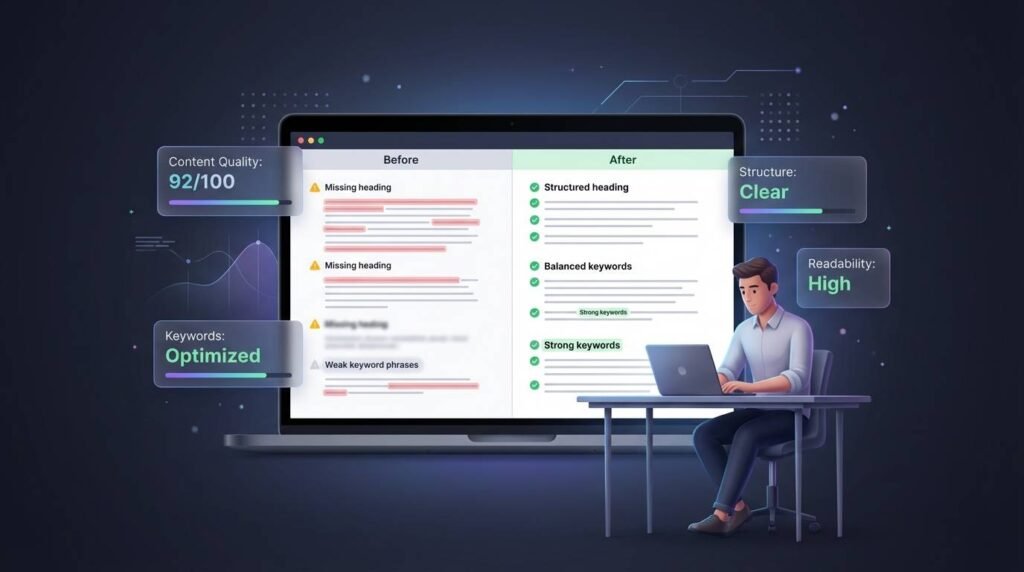
That’s exactly why this free content analysis tool exists. It shows you, in seconds, what Google and real users see when they land on your page. Not guesses. Not opinions. Actual content signals that affect rankings. Before you publish, you’ll know whether your content is strong enough—or needs fixing.
Whether you started blogging last week or you’ve been doing this for years, this free website content analysis tool catches mistakes you’d otherwise publish. Because we all miss stuff in our own writing, that’s how brains work.
What Is a Content Analysis Tool?
A content analysis tool reads your writing and tells you what’s wrong with it. Think of it like having an editor look over your shoulder, except faster and brutally honest. You write something. You read it five times. Looks perfect to you. But you’re too close to it. Your brain autocorrects mistakes. You know what you meant to say, so you see that instead of what you actually wrote. The tool doesn’t have that problem. It counts words. Checks where keywords appear. All the technical stuff that affects whether people can read your content and whether Google can rank it. Here’s why this matters. Say you write about gardening tips. You covered everything you know about tomatoes in 400 words. Feels complete to you. But Google’s top result is 1,800 words covering soil types, watering schedules, pest prevention, seasonal timing, and common mistakes. Your 400 words barely scratch the surface. An analysis tool would flag this immediately. “Your content is thin. Add more depth.” You’d know to expand before publishing. That’s what these tools do. They give you objective data instead of your own biased perception of your work.
Why Content Analysis Matters For SEO
Google’s job is to show people the best answers. Not good answers. The best ones. To find the best, Google’s algorithm scans pages for quality signals. Does this answer the question thoroughly? Is it easy to read? Is the information organized clearly? Does it match what people are searching for? Mess up these signals, and your page disappears into the void where nobody finds it. Thin content is poison. You know those pages with three sentences of useless text just trying to rank for a keyword? Google hates those. So do people. Nobody benefits from shallow, worthless pages. I’ve watched sites lose half their traffic overnight because they published too much thin garbage. Google’s updates hit them hard, and recovery took months of fixing or deleting weak pages. A content quality checker tool stops you from creating that problem. It measures depth. It shows when you’re not covering a topic thoroughly enough. It warns you before you damage your site’s reputation. User experience determines rankings more than people realize. Someone clicks your link from search results. They land on your page. If they immediately click back to Google, that’s a problem. That behavior tells Google your page didn’t satisfy them. Do that enough times, and Google stops showing your page to people. Why would someone immediately leave? Usually, because your content is hard to read. Giant paragraphs. Complicated sentences. No clear sections to scan. People bounce within three seconds. The thin content checker tool catches these readability killers. You’ll see which paragraphs are too long. Which sentences are too complex? Where you need subheadings. Small fixes that keep people reading. Fix the quality issues, and your rankings improve. Not tomorrow, but over weeks as Google notices people staying on your page longer.
How This Free Content Analysis Tool Works
First, write your content properly. Make sure your content follows this structure.
H1 must start with #
H2 must start with ##
H3 must start with ###
H4 must start with ####
H5 must start with #####
H6 must start with ######
In this tool, before pasting your content, write the meta title & meta description. And do not forget to add labels in Metas.
Example:
Meta title Free Content Analysis Tool – Find SEO Issues Before Ranking
Meta Description Find SEO problems, thin content, and gaps before you publish. Use this free content analysis tool to optimize smarter, not harder.
Then, copy your content. Grab everything from your title down to your last paragraph.
Paste it into the text box on the tool page. One click and drop it in. Click analyze. The tool scans it and shows you a report. Takes maybe 20 seconds total. The report is split into sections. You get scores for quality, keywords, structure, and readability. Under each score, you see specific problems and how to fix them.
You can use this free online content analysis tool as much as you want. Run it ten times while you’re editing. Check different pages. Compare old content to new stuff. No limits. I usually check content twice. Once, while I was writing to catch big problems. Once before publishing to make sure I didn’t miss anything. Works well.
What This Tool Checks In Your Content
The tool looks at several different aspects. Each one affects whether your content works or fails
Content Quality Check
Quality means covering your topic properly, not just throwing words on a page. The content quality checker tool starts with a word count. Articles under 300 words rarely rank unless they’re quick definitions. Google prefers content that goes deep. But word count alone doesn’t mean quality. You can write 2,000 words of repetitive nonsense. The tool looks at substance, too—are you actually covering the topic or just hitting a word count target? Originality separates good content from mediocre content. If you’re just repeating what everyone else says, why would anyone read your version? The tool can’t directly measure originality, but it spots when your coverage feels incomplete or surface-level. The thin content checker tool watches for specific red flags. Super short articles. Sections that repeat information. Content that doesn’t match what the title promises. Grammar problems hurt your credibility fast. One typo? Fine, everyone makes mistakes. But errors in every paragraph make you look careless or incompetent. The tool flags obvious mistakes worth fixing. You get a quality score plus a list of specific improvements. Maybe add 300 words on a topic you barely mentioned. Maybe restructure a confusing section. Maybe clean up awkward phrasing.
Keyword Usage And Optimization
Keywords tell Google what your content is about. Use them wrong, and Google gets confused about your topic. The tool checks keyword density—what percentage of your words is your target keyword? Under 0.5%, and Google might not realize that’s your focus. Over 3%, and you sound like spam. Where you put keywords matters as much as how many you use. Your main keyword should be in your title, opening paragraph, at least one heading, and sprinkled naturally in your content. I see beginner’s keywords everywhere, thinking that more equals better rankings. Not how it works anymore. Google detects unnatural repetition. If your content sounds weird when you read it out loud, you’ve gone too far. Related keywords make your content stronger. These are terms connected to your main topic. Writing about coffee makers? Related terms include brewing, espresso, grind settings, and water temperature. Using these naturally shows you actually know the topic. The tool shows you where you’re missing keyword opportunities. Maybe you only mentioned your main keyword once in 1,000 words. Maybe you forgot it in every heading. Easy fixes that help without making your writing sound robotic.
Content Structure And Headings
Structure is how you organize information. Good structure helps people find what they need. Bad structure makes everything feel like chaos. Headings follow a hierarchy. One H1 tag for your main title. H2 tags for major sections. H3 tags under those H2s for subsections. This creates a clear outline. The tool catches the mistakes people make constantly. Using three H1 tags confuses Google about your main topic. Jumping from H2 to H4 skips a level and breaks your outline. These details matter for how Google interprets your page. Heading length should stay reasonable. Really long headings (over 70 characters) get cut off in search results. Super short headings (one or two words) don’t give enough context. Aim for clear, descriptive headings around 5-10 words. Your content should flow logically. Introduction, main points in order of importance, and conclusion. Jumping randomly between topics confuses people. The tool spots when your organization feels off.
Readability And User Experience
Perfect keywords and structure mean nothing if people can’t read your content comfortably. The tool measures reading level. Grade 8 is ideal for most web content. Not because your readers are dumb, but because clear writing beats complicated writing every time. Paragraph length kills readability faster than anything else. On phones, paragraphs over 80 words look like solid walls of gray text. People’s eyes glaze over. Keep paragraphs between 2 and 4 sentences. Sentence variety keeps people engaged. All short sentences get choppy and annoying. All long sentences get exhausting. Mix them up. The tool flags when all your sentences run the same length. Passive voice weakens writing. “The analysis was performed by the tool” versus “The tool performed the analysis.” See the difference? Active voice is direct and stronger. The tool highlights passive construction so you can rewrite. Mobile matters because that’s where most people read. Over 60% of web traffic comes from phones now. Short paragraphs, clear headings, and simple language all make mobile reading easier.
Internal And External Links
Links connect ideas and show relationships between topics. Internal links point to other pages on your site. If you mention keyword research and you have an article about it, link to it. Keeps readers on your site and helps Google understand how your pages relate. The tool finds missing internal link opportunities. You mentioned a topic three times without linking to your existing guide on it. Easy win you probably missed while focused on writing. External links to good sources build trust. When you mention statistics or reference data, link to where you got it. Shows you did research instead of making stuff up. Broken links frustrate everyone. Someone clicks, expecting information, and gets an error page. Google sees this as poor site maintenance. The tool checks if your links actually work. Anchor text is the clickable words in a link. “Click here” is terrible anchor text. “Guide to on-page SEO” is good anchor text. It tells both users and search engines where the link goes.
Real Example: Content Analysis In Action
We tested a 650-word blog post before publishing.
The tool found:
• Only one use of the main keyword
• No subheadings under main sections
• Thin coverage compared to top-ranking pages
After fixing these issues, the content became easier to scan, more relevant to the topic, and better aligned with search intent. This is the difference between publishing content blindly and publishing content with confidence.
Free Content Analysis Tools vs. Paid Tools
Free tools handle fundamentals. Paid tools add features you might not need yet. Most free tools check word count, keywords, readability, and structure. If you’re starting or running a personal blog, these cover 90% of what matters. You’ll improve significantly without spending money. Paid tools go deeper. Bigger plagiarism databases. Advanced competitor analysis. Integration with other platforms. AI suggestions. Priority support when something breaks. Do you need that stuff? If you publish a couple of articles weekly for your own site, probably not. If you run an agency with twenty clients, maybe. Free tools let you learn without financial risk. Experiment. Make mistakes. Figure out what works. You invest time instead of money. This best content analysis tool free gives you professional-quality checks without subscriptions. You’re not missing critical features. Everything that affects rankings and reader engagement is covered. Start with free tools. If you outgrow them later, you’ll know exactly which paid features you actually need. Most people never reach that point.
Why This Is One Of The Best Free Content Analysis Tools
Most free tools only show word count and basic readability.
This tool goes further by combining:
• Content depth analysis
• Keyword placement checks
• Structural validation
• Readability and UX signals
You don’t just see a score. You see why your content passes or fails—and what to fix next. That’s why this tool works well as a final pre-publish check, not just a rough analyzer.
Best Tools For Content Optimization And Analysis
Content optimization isn’t about one magic tool. It’s a system of different checks working together. This analyzer fits into your workflow at multiple stages. Use it while drafting to spot problems early. Use it before publishing as a final check. Use it every few months to audit older content.
Combine it with other free resources for complete coverage. Keyword tools show what people search for. Grammar checkers catch typos and errors. SEO plugins verify meta descriptions and technical elements. The best tools for content optimization and analysis each handle specific jobs. This tool focuses on content quality and structure. Other tools cover different pieces. Together, they create a complete process. Like maintaining a car. You check oil separately from tire pressure and from brakes. Each check catches different problems. No single inspection covers everything, but together they keep you running smoothly. Make analysis a habit, not a one-time thing. Check everything you publish. Review existing content quarterly. Rankings change. Competitors improve. Your content needs ongoing attention.
How To Choose A Content Analysis Tool For SEO Optimization
The right tool depends on what you’re trying to accomplish. Start by defining your goal. Better rankings? More engagement? Fixing underperforming pages? Your goal shapes which features matter. Quality and readability checks are essential. If a tool doesn’t measure these, skip it. Well-written, easy-to-read content is the foundation on which everything else is built. Keyword analysis should be standard. You need to see if you’re using keywords effectively. Density, placement, natural usage—all of it matters. Structure analysis helps Google understand your page. Proper heading hierarchy and logical organization affect both readers and search engines. Simplicity beats features when you’re starting. A tool with fifty options sounds impressive, but creates confusion. You want clear reports with specific guidance. Budget determines free versus paid. Most bloggers and small businesses succeed with free tools. Only upgrade when you’re certain the paid features solve actual problems you’re facing. Speed and accuracy matter. Slow tools waste time. Inaccurate tools give bad advice that hurts rankings. Test options with real content before deciding. This tool checks every important box. Free, fast, accurate, and beginner-friendly. For SEO optimization, it provides what matters without unnecessary complexity.
Who Should Use This Tool
This free website content analysis tool works for anyone creating web content. Bloggers improve posts before publishing. Whether you write about cooking, finance, fitness, or technology, quality attracts readers and ranks better. The tool helps you match the quality of established sites. SEO beginners get guided learning. You see what matters instead of guessing. Check content, read suggestions, and make changes. Learn by doing. Digital marketers maintain consistency across projects. When handling multiple clients, quality needs to stay high everywhere. The tool provides objective feedback for every piece. Small business owners save time. You don’t have hours to perfect every page. The tool shows the most important fixes in seconds. Make changes and get back to running your business. Freelance writers deliver better work. Higher quality means happier clients and more opportunities. The tool helps you consistently exceed expectations. Students improve their assignments before submission. Better writing earns better grades. The tool shows how to organize ideas and write clearly. Anyone publishing content online benefits from objective analysis. It’s free and quick. No reason to publish without checking first.
Have Any Questions?*
Yes, completely free. No credit card. No trial that expires. No surprise charges. Analyze unlimited content whenever you want. The tool exists to help people publish better content regardless of budget.
Yes. The tool checks factors Google uses to evaluate quality. Better keywords, improved structure, higher readability, and thorough coverage—all contribute to better rankings. No tool guarantees the first page, but improving these elements increases your chances. Combine this with solid keyword research and technical SEO for the best results.
Check every new piece before publishing. For existing content, audit every three to six months. Google’s factors evolve, and older content might need updates to stay competitive. Regular analysis catches thin content, outdated information, and new opportunities. Routine maintenance keeps your site healthy.
Start Using The Free Content Analysis Tool Now
Your content deserves better than guesswork. Paste your text into the free content analysis tool right now. Get specific feedback on strengths and weaknesses. See exactly how to make your content clearer, more thorough, and more likely to rank. Every day you wait, competitors get ahead. They’re optimizing. Readers are searching for topics you cover. Google is deciding which pages deserve visibility. The tool is free and takes 20 seconds. No barriers. No complications. Just honest feedback. Click analyze. Review the report. Make changes. Watch your content perform better.
Your best content starts with one check. Do it now.
Would you like to start a project with us?
Grow your business online with Enneaagon—a leading data-driven digital marketing agency. Get real results. Book your free strategy call today.